The setting
Catania's Baroque, rebuilt after 1693
How the 1693 earthquake and Etna shaped Catania, who Vaccarini was, and what to look at in Piazza del Duomo and the Badia di Sant'Agata.
Reserve seats for the concert ↗A city that was rebuilt
Catania sits on Sicily's east coast at the foot of Mount Etna, the second-largest city on the island. In 1669 a lava flow from Etna nearly swamped it, and in 1693 a great earthquake nearly destroyed it. The city that visitors see today was largely rebuilt in the decades that followed, in the Baroque style, which is why its centre feels so unified. That history is part of the setting for a concert in the Badia di Sant'Agata, a church built as part of the rebuilding and still standing in the middle of it.
A UNESCO listing
Since 2002 the historic centre has carried UNESCO World Heritage status, as one of the Late Baroque Towns of the Val di Noto. The inscription groups towns in south-eastern Sicily that were rebuilt in the late Baroque manner after the 1693 earthquake. Catania is one of them, and its exuberant architecture is a main reason. For a visitor, the designation is a reminder that the whole centre, not one monument, is the attraction. The Badia and the cathedral are two pieces of a larger set.
Giovanni Battista Vaccarini
Vaccarini, an architect born in Palermo, is the name behind much of central Catania. Italy's tourism portal counts his work on the cathedral facade and the Badia di Sant'Agata as his main achievements in the city. His buildings use curves, carved cornices and decorated facades, and you can see the family resemblance as you cross the cathedral square. He was working in a city that needed to be rebuilt almost from scratch, so his work set the tone for the whole centre.
The elephant in the square
In Piazza del Duomo, in front of the cathedral, stands the symbol of the city, called u Liotru in the local dialect. It is a lava-stone elephant topped by an Egyptian obelisk, and it was assembled in 1736 by Vaccarini. The use of volcanic stone for the elephant ties the monument to Etna, which has shaped the city's story from the start, and the Egyptian obelisk on its back gives the fountain an unmistakable silhouette.
The cathedral
Catania Cathedral is dedicated to Saint Agatha. According to Wikipedia, Roger I of Sicily ordered its construction between 1078 and 1093 on the ruins of Roman baths, and the 1693 earthquake left it mostly in ruins before its Baroque rebuilding. Vaccarini designed the Baroque facade, which has three levels and granite Corinthian columns. Inside is the tomb of Vincenzo Bellini.
The Badia di Sant'Agata
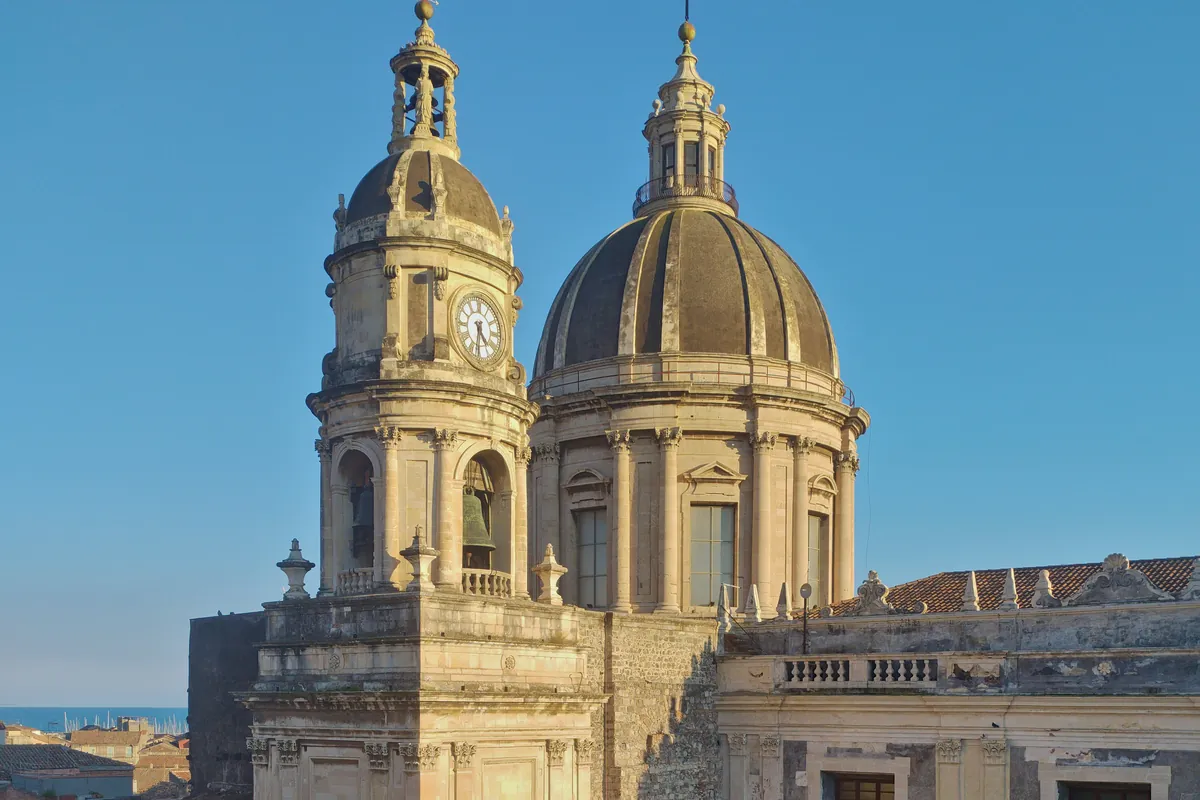
A Benedictine convent was founded on this site in 1620 and was destroyed in the 1693 earthquake. Building the new church began in the 1730s under Vaccarini, and the octagonal dome followed in the 1760s. The church was consecrated in 1796. A metal grille and a viewing balcony behind the main altar let the cloistered nuns follow Mass without being seen, a detail that makes the quiet interior easier to imagine.
Two Baroque neighbours
The Badia stands beside the cathedral, so Vaccarini's two great Catania churches stand side by side. Compare them: the cathedral has a columned facade, while the Badia is smaller and curving. Together they show how one architect could give a rebuilt city a consistent look without making two buildings alike. Look up at both from the square before the concert, and notice how the Badia's dome rises behind its curving facade. Then go in: the interior is calmer than the street outside, and it was designed to be seen from the nave.
Baroque and Bellini
Bellini was born in 1801, in a city whose Baroque centre had been rebuilt over the previous century. Today the same streets hold his birthplace museum, his tomb and his monument. To hear his music in a Vaccarini church, on a date from the booking calendar, is to take in the composer and the city's rebuilding in a single evening.
Sources